Table of Contents
ToggleIntroduction
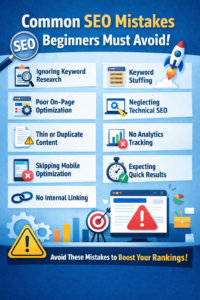
Search Engine Optimization (SEO) is one of the most powerful ways to grow your website traffic organically. However, beginners often make critical mistakes that prevent their websites from ranking on search engines like Google. To Know Common SEO Mistakes Beginners Must Avoid.
If you’re struggling to get traffic despite publishing content regularly, chances are you’re making some common SEO errors. In this guide, we’ll explore the most frequent SEO mistakes beginners must avoid and how to fix them effectively.
H2: Ignoring Keyword Research
H3: Why It Matters
Keyword research is the foundation of SEO. Without targeting the right keywords, your content may never reach your audience.To Know Common SEO Mistakes Beginners Must Avoid.
H3: Common Mistake
Many beginners:
- Guess keywords instead of researching
- Target highly competitive keywords
- Ignore search intent
H3: How to Fix It
Use tools like:
- Google Keyword Planner
- Ubersuggest
Focus on:
- Long-tail keywords
- Low competition terms
- User intent
H2: Poor On-Page SEO Optimization
To Know Common SEO Mistakes Beginners Must Avoid.
H3: What Goes Wrong
Beginners often:
- Skip meta titles and descriptions
- Ignore header tags (H1, H2, H3)
- Forget image ALT text
H3: Best Practices
- Use your focus keyword in:
- Title
- First paragraph
- Headings
- Write compelling meta descriptions
- Optimize images with ALT tags
H2: Creating Low-Quality Content
To Know Common SEO Mistakes Beginners Must Avoid.
H3: The Problem
Publishing thin or duplicate content can hurt rankings. Search engines prioritize valuable, original content.
H3: How to Improve
- Write in-depth content (800–1500 words)
- Solve real user problems
- Keep content unique and engaging
👉 Follow guidelines from Google Search Central for quality standards.
H2: Ignoring Mobile Optimization
H3: Why It’s Critical
Most users browse on mobile devices. Google uses mobile-first indexing.
H3: Common Issues
- Slow loading pages
- Poor design on mobile
- Unreadable text
H3: Solution
- Use responsive design
- Optimize page speed
- Test your site on different devices
H2: Not Using Internal Linking
H3: What Beginners Miss
Internal links help search engines understand your site structure.
H3: Benefits
- Improves crawling
- Boosts page authority
- Enhances user experience
H3: Best Practice
Link to:
- Related blog posts
- Important pages
H2: Lack of External Linking
H3: The Mistake
Some beginners avoid linking to other websites.
H3: Why It Matters
External links to authoritative sources increase trust.
H3: Example
Link to trusted platforms like:
- Moz
- Ahrefs
H2: Keyword Stuffing
H3: What It Is
Overusing keywords unnaturally in content.
H3: Why It Hurts
Search engines penalize keyword stuffing.
H3: Fix
- Write naturally
- Use synonyms and variations
- Maintain readability
H2: Ignoring Technical SEO
H3: Common Technical Issues
- Broken links
- Slow website speed
- Missing sitemap
H3: How to Fix
- Use SEO plugins like Rank Math
- Optimize site speed
- Submit sitemap to search engines
H2: Not Tracking SEO Performance
H3: The Mistake
Many beginners don’t analyze results.
H3: Tools to Use
- Google Analytics
- Google Search Console
H3: What to Track
- Traffic
- Keyword rankings
- Bounce rate
H2: Skipping Meta Tags Optimization
H3: Why It Matters
Meta tags influence click-through rates.
H3: Best Practices
- Keep title under 60 characters
- Meta description under 160 characters
- Include focus keyword
H2: Expecting Instant Results
H3: The Reality
SEO takes time. Beginners often quit too early.
H3: What to Do Instead
- Be consistent
- Publish regularly
- Update old content
Conclusion
Avoiding these common SEO mistakes can significantly improve your website’s performance. SEO is not just about ranking—it’s about providing value to users and building long-term credibility.
Focus on:
- Quality content
- Proper optimization
- Continuous improvement
By fixing these beginner mistakes, you can create a strong foundation for long-term success in SEO.
🔥 Bonus Tip (For Ranking Faster)
Regularly update your content and align it with the latest algorithm updates from Google to stay ahead of competitors.