Table of Contents
ToggleSearch is evolving rapidly. Users are increasingly receiving AI-generated answers instead of simply clicking through a list of search results. Google AI Overviews, ChatGPT, Gemini, and Perplexity are changing how information is discovered and consumed. Therefore Generative Engine Optimization becomes essential.
To remain competitive, website owners need to understand Generative Engine Optimization (GEO) while continuing to apply proven SEO principles. Together, GEO and traditional SEO can help improve your website’s visibility in both search engine results and AI-generated responses.
Table of contents:
- What Is Generative Engine Optimization?
- How AI Search Is Changing SEO
- GEO vs Traditional SEO
- 10 Best Practices to Rank in AI Search
- Common GEO Mistakes
- GEO Checklist
- FAQs
- Conclusion
H.2 What Is Generative Engine Optimization (GEO)?
Definition of GEO
Generative Engine Optimization (GEO) is the practice of creating content that AI-powered search systems can easily understand, summarize, and reference in their responses. Rather than focusing only on ranking in search results, GEO aims to make your content useful enough for AI systems to cite or rely on when answering users’ questions.
Why GEO Matters in 2026
AI-powered search tools are becoming a primary source of information for many users. Businesses that adapt their content strategy now are more likely to remain visible as search behavior continues to evolve for Generative Engine Optimization(GEO}.
Benefits of GEO include:
-
- Better visibility in AI-generated answers
-
- Increased brand authority
-
- Higher trust among users
-
- Improved long-term organic traffic
-
- Better content quality Generative Engine Optimization (GEO)
H.3 How AI Search Is Changing SEO
Google AI Overviews
Google now provides AI-generated summaries for many informational searches. These summaries often appear before traditional search results, making high-quality, trustworthy content more valuable than ever.
ChatGPT, Gemini, and Perplexity
Millions of users now ask AI assistants for recommendations, explanations, and product information. These systems favor content that is clear, well-organized, and backed by expertise.
The Shift from Rankings to Answers
Traditional SEO focused primarily on ranking in the top search positions. Today, success also means creating content that AI systems consider reliable enough to reference in generated responses.
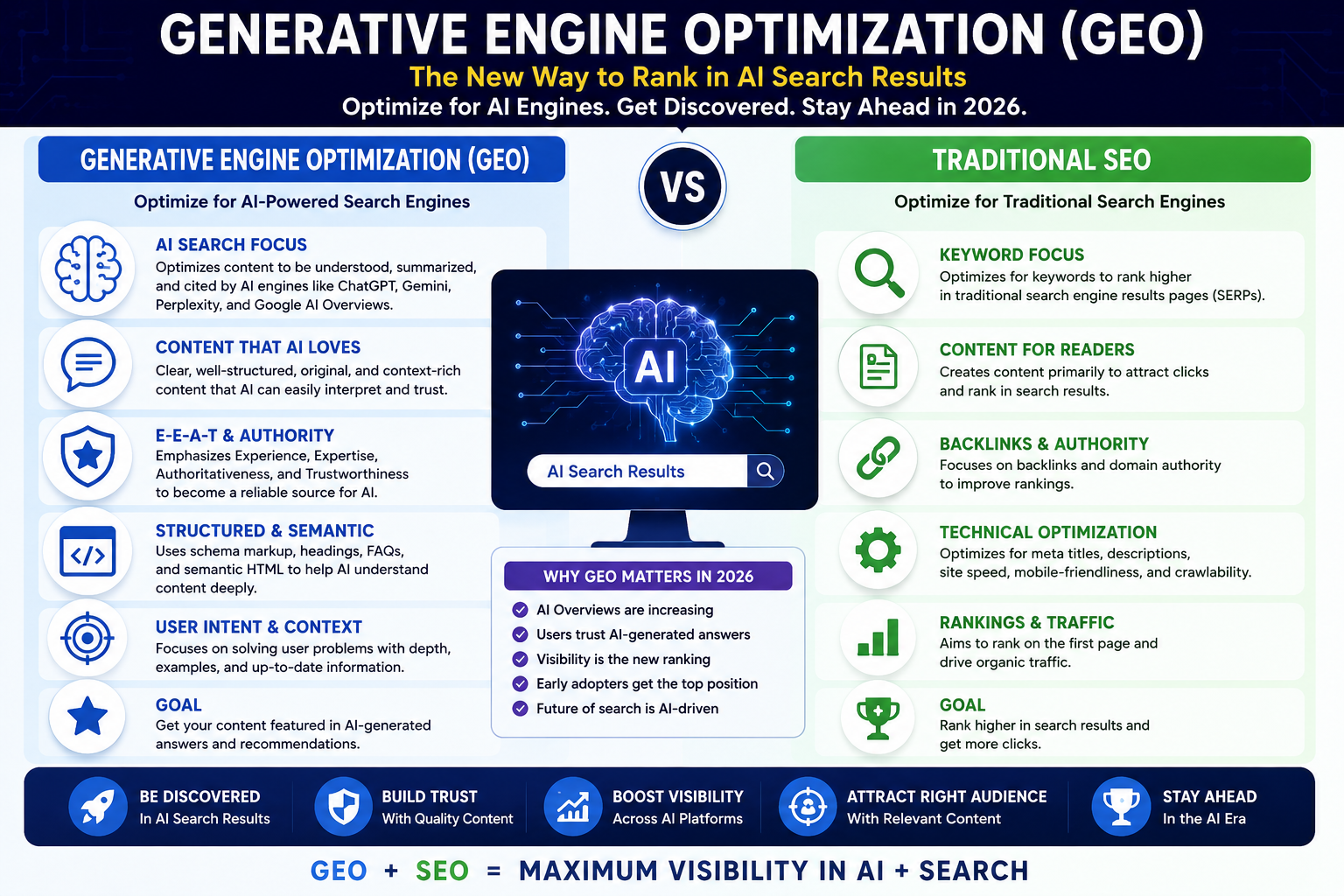
H.4 GEO vs Traditional SEO
Key Differences
| Traditional SEO | Generative Engine Optimization |
|---|---|
| Focuses on Google rankings | Focuses on AI-generated answers |
| Keyword optimization | Context optimization |
| Link building | Authority and trust |
| Search result visibility | AI citation visibility |
| CTR optimization | AI answer optimization |
Similarities Between GEO and SEO
Although GEO introduces new opportunities, it still depends on many traditional SEO fundamentals:
-
- High-quality content
-
- Technical SEO
-
- Fast website speed
-
- Mobile-friendly design
-
- Strong internal linking
-
- Quality backlinks
H.5 :10 Best Practices to Rank in AI Search
Create Helpful and Original Content
Write content that answers real user questions instead of simply targeting keywords.
Demonstrate Experience and Expertise
Share practical examples, case studies, and real-world insights. Original experience helps build trust.
Use Clear Heading Structure
Organize every article using logical H1, H2, and H3 headings so readers and AI systems can understand your content more easily.
Optimize for Search Intent
Understand why users search for a topic and ensure your content directly satisfies their needs.
Build High-Quality Backlinks
Authoritative backlinks remain one of the strongest trust signals for both traditional search engines and AI systems.
Add Schema Markup
Use structured data such as Article, FAQ, and Breadcrumb Schema to improve content understanding.
Improve Website Speed
Fast-loading websites provide a better user experience and contribute to improved search performance.
Strengthen Internal Linking
Connect related articles so users and search engines can navigate your website efficiently.
Update Content Regularly
Refresh your articles with new examples, statistics, and recommendations to maintain relevance.
Optimize for Featured Snippets
Provide concise answers, numbered lists, and tables that search engines can easily display.
H.6 Common GEO Mistakes to Avoid
Publishing Thin AI Content
Simply generating articles with AI without adding original insights often results in low-quality content.
Ignoring Search Intent
Writing about a topic without understanding what readers actually need reduces the value of your content.
Weak Internal Linking
Failing to connect related pages limits your website’s authority and user engagement.
Missing Author Information
Adding author details and demonstrating expertise helps improve trustworthiness.
H.7 GEO Checklist for 2026
Content Quality
-
- Original research
-
- Helpful explanations
-
- Clear language
-
- Updated information
Technical SEO
-
- Fast loading speed
-
- Mobile optimization
-
- Secure HTTPS website
-
- XML sitemap
-
- Proper robots.txt configuration
Trust Signals
-
- Author biography
-
- Contact information
-
- Quality backlinks
-
- Positive user experience
H.8 Frequently Asked Questions
What is Generative Engine Optimization?
Generative Engine Optimization (GEO) is the process of creating content that AI-powered search systems can understand, summarize, and reference in their responses.
Is Traditional SEO Still Important?
Yes. Technical SEO, quality content, backlinks, and user experience remain essential for long-term search success.
Can GEO Replace SEO?
No. GEO complements traditional SEO. The strongest digital strategy combines both approaches.
How Can Small Businesses Benefit from GEO?
Small businesses can improve online visibility by publishing helpful, authoritative content and maintaining a technically optimized website.
H.9 Final Thoughts
Artificial intelligence is reshaping how people search for information, but the foundation of successful SEO remains unchanged: create valuable content that helps users. By combining Generative Engine Optimization (GEO) with proven SEO practices, you can improve your chances of appearing in traditional search results as well as AI-generated responses.
Instead of choosing between GEO and SEO, use them together. Websites that demonstrate expertise, maintain technical excellence, and consistently publish high-quality content will be better positioned for long-term success in 2026 and beyond.
H10. Conclusion
Search is entering a new era where AI-powered answers are becoming a standard part of the user journey. Businesses that invest in authoritative content, technical optimization, and trust-building strategies today will be better prepared for tomorrow’s search landscape.
At PadmaBlog, we believe the future belongs to websites that prioritize helpful content, ethical SEO practices, and continuous learning. Start optimizing for both Google and AI search today to build sustainable online growth.
Lorem ipsum dolor sit amet, consectetur adipiscing elit. Ut elit tellus, luctus nec ullamcorper mattis, pulvinar dapibus leo.