Table of Contents
ToggleWhat Is a Technical SEO Audit?
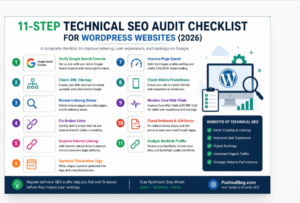
11 powerful steps for technical and SEO audit.
Implementing a technical SEO audit checklist is the process of analyzing a website’s technical elements to ensure search engines can crawl, index, and rank pages efficiently. A well-optimized website improves user experience and increases organic search visibility.
For WordPress websites, regular technical SEO audit checklist help identify indexing issues, broken links, slow page speed, duplicate content, and other factors affecting Google rankings.
Technical SEO Audit Checklist
H1. Verify Google Search Console Setup
Google Search Console is a free SEO tool that helps website owners monitor indexing and search performance of Technical SEO and Audit Checklist.
Check
H1.1Property verification XML sitemap submission
H1.2. Coverage reports
H1.3. Manual actions
H1.4. Security issues
H2. Review Website Indexing
Use Google Search Console to identify for Technical SEO and Audit checklist.
H2.1 Indexed pages
H2.2 Excluded pages
H2.3 Crawled but not indexed URLs
H2.4 Duplicate pages
Ensure important pages are indexed and accessible to search engines.
H3. Check XML Sitemap
An XML sitemap helps Google discover website content quickly. Therefore technical SEO and Audit Checklist helps.
Best practices:
h3.1 Include all important pages
H3.2 Remove deleted URLs
H3.3 Submit sitemap in Search Console
H3.4 Update automatically after publishing content
H4. Fix Broken Links
Broken links create poor user experience and waste crawl budget for Technical SEO Audit checklist.
Tools:
H4.1 Google Search Console
H4.2 Broken Link CheckerH
H4.3 Screaming Frog SEO Spider
Solutions:
-
- Update incorrect URLs
-
- Create redirects
-
- Restore deleted pages when necessary
H5. Improve Internal Linking
Internal links help distribute authority across pages for technical SEO audit checklist.
Benefits:
H5.1 Better crawlability
H5.2Improved user engagement
H5.3 Faster indexing
H5.4 Stronger keyword relevance
Link related blog posts naturally within content.
H6. Optimize Meta Titles and Descriptions
Every page should have:
H6.1Unique title tags
H6.2 Unique meta descriptions
H6.3 Target keywords
H6.4 Clear user intent
Well-written metadata can improve click-through rates for technical SEO audit checklist.
H7. Improve Website Speed
Page speed is an important ranking factor.
Optimization tips:
H7.1 Compress images
H7.2 Enable caching
H7.3 Minify CSS and JavaScript
H7.4 Use a CDN
H7.5 Choose quality hosting
8. Check Mobile Friendliness
H8.1 Google uses mobile-first indexing.
Ensure:
Responsive design
Readable text
-
- Fast mobile loading
-
- Proper spacing between elements for technical SEO audit checklist.
H9. Monitor Core Web Vitals
Core Web Vitals measure user experience.
Key metrics:
H9.1Largest Contentful Paint (LCP)
H9.2 Interaction to Next Paint (INP)
H9,3 Cumulative Layout Shift (CLS)
Use PageSpeed Insights to identify improvements.
H10. Review Backlink Profile
Quality backlinks help build authority.
Focus on:
H10.1Relevant websites
H10.2Industry-specific directories
H10.3 Business citations
-
- Guest posting opportunities
Avoid spammy backlink schemes that may harm rankings.
H11.Common Technical SEO Problems That Affect Rankings
Many websites fail to rank well because of technical issues that prevent Google from properly crawling and indexing content. Some of the most common problems include:
H11.1 Missing XML sitemaps
H11.2 Duplicate title tags
H11.3 Duplicate meta descriptions
H11.4 Slow page speed
H11.5 Orphan pages without internal links
H11.6 Broken internal links
H11.7 Incorrect redirects
H11.8 Mobile usability issues
H11.9 Missing image alt text
Regular audits help identify these issues before they impact search performance.
CONCLUSION
A technical SEO audit is essential for maintaining website health and improving Google rankings. By regularly reviewing indexing, page speed, internal linking, metadata, and backlinks, WordPress website owners can build a strong SEO foundation for long-term growth.
At PadmaBlog, we focus on practical SEO strategies including Google Search Console setup, sitemap submission, technical SEO audits, indexing optimization, backlink analysis, and WordPress SEO improvements.
Keywords targeted: Technical SEO Audit, WordPress SEO, Google Search Console, Sitemap Submission, Indexing Issues, Broken Links, Internal Linking, SEO Audit, Checklist, Core Web Vitals, Website optimization.
A comprehensive technical SEO audit is essential for maintaining a healthy WordPress website and improving search engine rankings. By regularly reviewing indexing status, sitemap submissions, page speed, internal linking, Core Web Vitals, and backlink profiles, website owners can create a strong SEO foundation.
Successful SEO is not a one-time task but an ongoing process. Consistent monitoring, content optimization, and technical improvements help websites achieve better visibility, higher rankings, and increased organic traffic over time.
At PadmaBlog, we specialize in Technical SEO, WordPress SEO, Google Search Console setup, sitemap submission, indexing issue resolution, backlink analysis, and website optimization to help businesses improve their online presence.